Fosgate wrote:
Can be? Can I get a "is being" or at least a "has been"? You know, the sun going nova can overwhelm anything from high tide to dirty underwear.
There is so much evidence that Clouds have completely overwhelmed the CO2 effect in the past, and are currently doing so. Let's start off with the basics, which is to figure out what is the dominant driver of the Climate System. Is it Anthropogenic CO2 or is it a natural cycle? To begin to determine this, we have to look at the equator for the monthly OLR that is escaping Earth's atmosphere. This is where we can look at OLR changes with the most accuracy, since the Tropics do not experience as much seasonal variation or albedo change as the NH or SH do, so to get rid of all of this noise that might influence the average OLR at the TOA we look at the Tropics.

The Climate Models have predicted a "hot spot" for CO2 doubling to appear by the Tropics. This is because of the hypothesized positive water vapour and cloud feedback at the Tropics. However, none of this has been observed at all. In fact, we observe an increase in OLR at the Tropics, which could validate
Lindzen, Hou, and Chou's hypothesis which is known as the "Iris effect." It bascially states that as the planet warms, Cirrus clouds will decrease, which would allow for more OLR to reach the TOA, and produce a negative feedback on Earth's Climate. Two new peer reviewed papers document strong negative feedback from Cloud Cover. (
SOURCE) (
SOURCE)
Quoting respectably from the papers:
Quote:
We find that globally adding a uniform 1 W m − 2 source of latent heat flux along with a uniform 1 W m − 2 sink of sensible heat leads to a decrease in global mean surface air temperature of 0.54 ± 0.04 K. This occurs largely as a consequence of planetary albedo increases associated with an increase in low elevation cloudiness caused by increased evaporation. Thus, our model results indicate that, on average, when latent heating replaces sensible heating, global, and not merely local, surface temperatures decrease.
Quote:
The CAM-SP shows strongly negative net cloud feedback in both the tropics and in the extratropics, resulting in a global climate sensitivity of only 0.41 K/(W m-2), at the low end of traditional AGCMs (e.g. Cess et al. 1996), but in accord with an analysis of 30- day SST/SST+2K climatologies from a global aquaplanet CRM run on the Earth Simulator (Miura et al. 2005). The conventional AGCMs differ greatly from each other but all have less negative net cloud forcings and correspondingly larger climate sensitivities than the
superparameterization. The coarse horizontal and vertical resolution of CAM3-SP means that it highly under-resolves the turbulent circulations that produce boundary layer clouds. Thus, one should interpret its predictions with caution. With this caveat, cloud feedbacks are arguably more naturally simulated by superparameterization than in conventional AGCMs [conventional climate models], suggesting a compelling need to better understand the differences between the results from these two approaches.

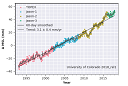
The OLR has increased roughly 4.5 w/m^2 per decade on average, since 1979. (
SOURCE) This equates to roughly a 11-13 w/m^2 increase in OLR over this timeframe. It also indicates that something else other than CO2 is adding Energy to Earth's Energy Budget, since this roughly 10X CO2's RF since
1790. The increase in OLR at the Tropics indicates that Cloud Cover may be most of the reason that OLR has increased by the Tropics, since when Clouds are subtracted from the Global Energy Flows, you get more Incoming Shortwave Radiation that reaches Earth's surface, thus warming Earth, and producing a continued increase in OLR. You get increasing OLR from two sources: decreasing Cloud Cover, since Clouds trap OLR and increasing ISR, which continually increases OLR.
Indeed, multiple sources have confirmed that albedo has decreased since the beginning of measuring the albedo, with one being the ISSCP, and the second being Earthshine.

ISSCP has confirmed that Cloud Cover has decreased by roughly 4-5% from 1983-2000, which when Global Warming was occuring. Since then, Cloud Cover has flatlined, and Global Temperatures have followed suit, instead of increasing, like they should have if CO2 was the dominant driver of the Climate.

The Earthshine experiment calculates albedo through reflected incoming shortwave radiation from albedo changes, that reflects off of the moon. More information on the Earthshine experiment can be found here: (
LINK)
Through Dr. Phillip Goode and Dr. Enric Palle's calculations, they found that the albedo reconstruction is in very good agreement with ISSCP- that it has decreased substantially and has added several w/m^2 of energy to Earth's Energy Budget.

The blue and black lines are albedo reconstructions, and the red line is the amount of Energy GHGs have added to Earth's Energy Budget since 1790. They are dwarfed entirely by just albedo changes alone. Albedo added 7-8 w/m^2 of Energy to Earth's Energy Budget up until 1790, which probably explains about all of the warming that took place during that time frame.
In their peer reviewed paper, the two solar scientists highlight that cloud variability is likely to account for Global Warming that occured during the late 20th Century. (
SOURCE)
For a lay approach, Dr. Palle has put the Earthshine findings into
one powerpoint slideshow.
Clouds act as a forcing and as a feedback. So how do we know that most of the decrease in Cloud Cover is simply not a product of warming temperatures, resulting in a positive feedback from increased Carbon Dioxide?
We know that most of the increase in temperature from clouds has not been a positive feedback, because water vapour has not increased at all. With a warmer Earth, the theory is that there will be less water vapour molecules that will be able to condense into Clouds because the planet heats up. You would find a surplus of moisture in the air, if this were to be the case. But you don't.

The graph above is from the NASA Water Vapor Project (NVAP) and shows that over the course of the years, there has been a negative water vapour anomaly that has begun to show up in recent years- meaning that water vapour is decreasing, and that the water cycle is slowing down, contrary to the positive feedback hypothesis, where the water cycle should speed up.
But what could be impacting Clouds if the decrease in Cloud Cover is not due to a positive feedback from warming?
Galactic Cosmic Rays are likely causing the decrease in Cloud Cover, and there is so much evidence that points to Cosmic Rays as being the primary driver of cloud cover changes.
Just this year, the CERN experiment
has proven that Cosmic Rays can alter aerosol production.
The graph above from Kirkby et. al 2011, show that as more and more Cosmic Rays impact the air, more and more aerosoles are produced, which are the seedlings to cloud formations. When a water vapour molecule condenses on an aerosol, you get a cloud. More of these aerosoles would mean that more clouds would form, and thus, more GCRs have a cooling influence on Earth.
But the most damning piece of evidence that Cosmic Rays are the primary drivers of Cloud Cover are from the FD evidence.
Forbush Decreases occur when high amounts of Coronal Mass Ejections cause there to be sudden subtantially less amounts of GCRs than normal. If GCRs are the primary drivers of Climate Change, you would expect a 5-10 day lag with the amount of aerosoles in the atmosphere after a Forbush decrease. And this is what observational evidence is saying.

The dashed line from
Svensmark 2009is the GCR count and the solid blue line is the aerosol number. A short lag in Global aersoles can clearly be seen right after a Forbush Decrease, which indicates a significant CR-Influence on climate, if Forbush Decreases can have that much of an impact on aerosoles.
In addition, we have
this new paper, which is the straw that broke the camel's back in terms of evidence that supports a CR-Influence on Climate.
From the conclusions:
Quote:
The superposed epoch analysis confirmed the statistically
significant influence of CR intensity decrease on the state of
the atmosphere. The effect is visible only if FDs exceeding
the threshold (7% amplitude with the Mt. Washington data)
are considered. The result strongly supports the idea that
cosmic rays influence the atmospheric processes and climate.

The group of physicists found that daytime temperatures are increasing faster than daytime temperatures with Forbush decreases, which strongly supports the CR driving Cloud Cover driving Climate Theory. This is because clouds reflect ISR in the daytime, cooling off daytime temperatures, and trap LWR at night. With decreases in Cloud Cover, you would get daytime temperatures warming faster than nighttime temperatures, which would get you a larger diurnal temperature change, and this is what has been observed.
There is even more evidence than this for example, that climate sensitivity is low, but I just gave you a taste of all of the evidence that is out there that supports that about all of the climate change that occured in the late 20th Century- the timeframe where CAGW scientists say that this is where natural cycles can no longer explain Global Warming.